 Alan Culpepper training in Boulder, Colo. Elite distance runners have
physiological traits that make them faster than the rest of us.
The marathon at the Olympics in Athens this month is fearsome, so
grueling that even an elite athlete is liable to feel at least a moment
of trepidation. The 26-mile, 385-yard course includes, among other
body-bashing stretches, a 13-mile hill so steep it has been described as
the equivalent of running up a five-story building every mile.
Your everyday, normal sort of runner, like me, will be breathless just
watching. But many of the Olympic runners will make it look easy.
I can run up that mountain only in my dreams, no matter how hard I work.
The difference between me and them is so great that I find myself
consumed with curiosity over exactly how much of running fast and far is
innate, and how much can be attributed to training, motivation and
technique.
I wonder how those remarkable athletes got to be who they are. And I
wonder what they know, and what, if anything, people like me can learn
to be more accomplished.
I have learned a thing or two close to home. I watched as my son took
off like a gazelle when he was in middle school, uncoached and
untrained, and went on to be a high school track and cross country star,
and then to run on the varsity teams at a Division I university. He gave
me tips - relax your upper body, run on your mid-foot, raise your knees
- and they helped. But I always knew that there was a fundamental
difference between him and me when it came to running far and fast. We
still run together, but all that means is that we start out at the same
place and end up at the same place. In between, he loses me.
On the other hand, my son learned in college that there also was a
noticeable difference between him and the runners who went on to become
national champions. And it was not a matter of trying harder.
Researchers say elite distance runners share several inborn
physiological traits, including large hearts, an efficient way of moving
and an ability to keep running when they are exerting so much effort
that they are panting for breath, that make them faster than most
recreational runners.
They also naturally avoid the sort of errors in technique that Dr.
Robert Fitts, an exercise physiologist and competitive runner at
Marquette University, sees in recreational athletes who run in 5- and
10-kilometer road races.
For example, Dr. Fitts says, many recreational runners turn their feet
out to the side rather than keeping them in a straight line. That wastes
energy and slows runners down.
"Your feet should go out one in front of the other," Dr. Fitts
explained. "It is not very difficult to learn. I used to run along the
line that is painted on a track and I would concentrate on both feet
hitting that line."
Stride length, Dr. Fitts said, is also important.
"If you have the proper stride length when you push off, then you get
the proper extension and flexion," he said. "If you take too short of a
stride, you look like a shuffler. If it is too long, you look like you
are bouncing. A good runner should almost be able to run with an apple
on their head."
Finally, Dr. Fitts advised, many people hold their arms too high, making
their shoulder muscles work while they run. "It is better to hold your
arms along your waist, with bent elbows," he said.
He added that these are all errors that can be corrected.
"Most people don't know these things just because they start to run," he
said "Somebody has to tell you. But most people at these road races are
very inefficient. They never were taught at all."
With elite runners, the question is not so much technique but rather the
tiny physiological differences that make one smooth, relaxed, fast
runner win every race while another, who looks equally good, falls
behind.
Exercise physiologists say there are three components to great running:
A high VO2 max, the volume of oxygen an athlete can consume at maximum
exertion; great running efficiency, a measurement of the energy used to
run at a particular pace; and an ability to keep going at a high level
of exertion for a long time, expressed as the percentage of VO2 max that
can be sustained during a run.
Athletes with a high VO2 max can pump large volumes of blood to their
muscles, usually because they have large and powerful hearts, said Dr.
Paul Ribisl, an exercise physiologist and a runner at Wake Forest
University. The heart of an average adult pumps about 15 liters a
minute. The heart of an elite distance runner typically pumps at least
twice that amount.
VO2 max increases with training, as a person goes from physically unfit
to physically fit. But, physiologists say, even when elite runners are
out of training - when they have not run for months or longer - they
have a VO2 max substantially higher than that of a recreational runner.
Competitive runners are also efficient, exerting themselves less than
those with less talent.
Conventional wisdom says the energy required to run a mile is the same,
no matter whether you are fast or slow. But it turns out that elite
runners simply do not work as hard as the less able.
In a study of elite runners, good runners and untrained, but equally
physically fit runners, Dr. Don Morgan, an exercise physiologist and
recreational runner at Middle Tennessee State University, and his
colleagues found that the better the runners were, the less effort they
exerted running at a particular pace.
But within a group of equally good runners, there were profound
differences in efficiency. In treadmill tests, Dr. Morgan found that one
runner could end up burning 20 percent more calories than another
running the same distance at the same speed.
The inefficient runners were not necessarily those who looked more
awkward as they ran.
"Some runners in our lab don't look good when they run, but they are
very economical," Dr. Morgan said. "Others are aesthetically beautiful
but are not economical."
Exercise physiologists are focusing on ways to make runners more
efficient. They speculate that a number of factors might determine
efficiency, and that some, like the biochemistry of the runner's muscles
or the structure of the runner's body, are simply innate. But one
factor, stride length, might be amenable to change.
About 20 percent of the competitive runners that Dr. Morgan and his
colleagues tested were overstriding, or taking steps too large for
maximum efficiency. None were taking steps that were too small. The
researchers set out to train the overstriders to take shorter steps.
For three weeks, five times a week, the athletes ran on treadmills at
the physiology lab, their pace set by the beat of a metronome. That
rhythm forced the runners to shorten their strides, and, as a
consequence, they ran about 3 percent faster.
"For someone like me, it wouldn't make any difference," Dr. Morgan said.
"But for an elite runner, that small percentage change could mean a big
deal."
The third characteristic that elite runners have, but that can also
improve with training, is an ability to continue running for long times
at a high level of exertion, the so-called anaerobic threshold. That
pace, said Dr. David Martin, an exercise physiologist at Georgia State
University, is "when the conversation stops and the work begins." If you
can carry on a conversation while you are running, he said, you have not
reached it.
For runners to increase the amount of time they can run at their
anaerobic threshold, they have to run at that level in training, exercise
physiologists say.
"Good American runners do train at an anaerobic threshold pace," Dr.
Martin said. "But sometimes these runners, they're little studs. They
get out there running, but, they say: 'This feels so easy. I know the
coach said 10 miles at anaerobic threshold, but I'll just pick up the
pace.' Then they are overtraining."
The result, he said, is poor performance.
While a high VO2 max, great efficiency and an ability to run long
distances at the anerobic threshold are common in elite distance
runners, few excel at all three.
Dr. Morgan and Dr. Jack Daniels at the State University of New York at
Cortland, for example, studied elite runners who were equally fast. Some
would have a high VO2 max, but lower economy than their peers, or vice
versa.
As for the rest of the population, improvement is possible, but no
amount of training can turn a person who is not gifted into an elite
athlete. This became clear to one researcher, Dr. Robert R. Wolfe, when,
in graduate school, he began running with Brook Thomas, a friend who had
come in fourth in the Olympic trials.
Dr. Wolfe, now the director of the metabolism branch at the University
of Texas Medical Branch at Galveston, had run competitively in college.
But running with his friend, he always lagged behind.
At one point, Mr. Thomas was injured, and he did not run for five
months. When he was ready to return to running, he called Dr. Wolfe and
suggested they run together.
They set off at a fast clip, with Mr. Thomas setting a five-and-a-half
minute-per-mile pace.
"I was just dying, trying to keep up," Dr. Wolfe recalled.
He accosted Mr. Thomas. How could it be that after all those months away
from running, he could cruise along at such a speed, with no apparent
effort? Mr. Thomas replied that he had always been able to run at that
pace.
"That was a watershed for me," Dr. Wolfe said. "That's when I realized
that no matter how hard I train, I will never get to that level."
Alan Culpepper training in Boulder, Colo. Elite distance runners have
physiological traits that make them faster than the rest of us.
The marathon at the Olympics in Athens this month is fearsome, so
grueling that even an elite athlete is liable to feel at least a moment
of trepidation. The 26-mile, 385-yard course includes, among other
body-bashing stretches, a 13-mile hill so steep it has been described as
the equivalent of running up a five-story building every mile.
Your everyday, normal sort of runner, like me, will be breathless just
watching. But many of the Olympic runners will make it look easy.
I can run up that mountain only in my dreams, no matter how hard I work.
The difference between me and them is so great that I find myself
consumed with curiosity over exactly how much of running fast and far is
innate, and how much can be attributed to training, motivation and
technique.
I wonder how those remarkable athletes got to be who they are. And I
wonder what they know, and what, if anything, people like me can learn
to be more accomplished.
I have learned a thing or two close to home. I watched as my son took
off like a gazelle when he was in middle school, uncoached and
untrained, and went on to be a high school track and cross country star,
and then to run on the varsity teams at a Division I university. He gave
me tips - relax your upper body, run on your mid-foot, raise your knees
- and they helped. But I always knew that there was a fundamental
difference between him and me when it came to running far and fast. We
still run together, but all that means is that we start out at the same
place and end up at the same place. In between, he loses me.
On the other hand, my son learned in college that there also was a
noticeable difference between him and the runners who went on to become
national champions. And it was not a matter of trying harder.
Researchers say elite distance runners share several inborn
physiological traits, including large hearts, an efficient way of moving
and an ability to keep running when they are exerting so much effort
that they are panting for breath, that make them faster than most
recreational runners.
They also naturally avoid the sort of errors in technique that Dr.
Robert Fitts, an exercise physiologist and competitive runner at
Marquette University, sees in recreational athletes who run in 5- and
10-kilometer road races.
For example, Dr. Fitts says, many recreational runners turn their feet
out to the side rather than keeping them in a straight line. That wastes
energy and slows runners down.
"Your feet should go out one in front of the other," Dr. Fitts
explained. "It is not very difficult to learn. I used to run along the
line that is painted on a track and I would concentrate on both feet
hitting that line."
Stride length, Dr. Fitts said, is also important.
"If you have the proper stride length when you push off, then you get
the proper extension and flexion," he said. "If you take too short of a
stride, you look like a shuffler. If it is too long, you look like you
are bouncing. A good runner should almost be able to run with an apple
on their head."
Finally, Dr. Fitts advised, many people hold their arms too high, making
their shoulder muscles work while they run. "It is better to hold your
arms along your waist, with bent elbows," he said.
He added that these are all errors that can be corrected.
"Most people don't know these things just because they start to run," he
said "Somebody has to tell you. But most people at these road races are
very inefficient. They never were taught at all."
With elite runners, the question is not so much technique but rather the
tiny physiological differences that make one smooth, relaxed, fast
runner win every race while another, who looks equally good, falls
behind.
Exercise physiologists say there are three components to great running:
A high VO2 max, the volume of oxygen an athlete can consume at maximum
exertion; great running efficiency, a measurement of the energy used to
run at a particular pace; and an ability to keep going at a high level
of exertion for a long time, expressed as the percentage of VO2 max that
can be sustained during a run.
Athletes with a high VO2 max can pump large volumes of blood to their
muscles, usually because they have large and powerful hearts, said Dr.
Paul Ribisl, an exercise physiologist and a runner at Wake Forest
University. The heart of an average adult pumps about 15 liters a
minute. The heart of an elite distance runner typically pumps at least
twice that amount.
VO2 max increases with training, as a person goes from physically unfit
to physically fit. But, physiologists say, even when elite runners are
out of training - when they have not run for months or longer - they
have a VO2 max substantially higher than that of a recreational runner.
Competitive runners are also efficient, exerting themselves less than
those with less talent.
Conventional wisdom says the energy required to run a mile is the same,
no matter whether you are fast or slow. But it turns out that elite
runners simply do not work as hard as the less able.
In a study of elite runners, good runners and untrained, but equally
physically fit runners, Dr. Don Morgan, an exercise physiologist and
recreational runner at Middle Tennessee State University, and his
colleagues found that the better the runners were, the less effort they
exerted running at a particular pace.
But within a group of equally good runners, there were profound
differences in efficiency. In treadmill tests, Dr. Morgan found that one
runner could end up burning 20 percent more calories than another
running the same distance at the same speed.
The inefficient runners were not necessarily those who looked more
awkward as they ran.
"Some runners in our lab don't look good when they run, but they are
very economical," Dr. Morgan said. "Others are aesthetically beautiful
but are not economical."
Exercise physiologists are focusing on ways to make runners more
efficient. They speculate that a number of factors might determine
efficiency, and that some, like the biochemistry of the runner's muscles
or the structure of the runner's body, are simply innate. But one
factor, stride length, might be amenable to change.
About 20 percent of the competitive runners that Dr. Morgan and his
colleagues tested were overstriding, or taking steps too large for
maximum efficiency. None were taking steps that were too small. The
researchers set out to train the overstriders to take shorter steps.
For three weeks, five times a week, the athletes ran on treadmills at
the physiology lab, their pace set by the beat of a metronome. That
rhythm forced the runners to shorten their strides, and, as a
consequence, they ran about 3 percent faster.
"For someone like me, it wouldn't make any difference," Dr. Morgan said.
"But for an elite runner, that small percentage change could mean a big
deal."
The third characteristic that elite runners have, but that can also
improve with training, is an ability to continue running for long times
at a high level of exertion, the so-called anaerobic threshold. That
pace, said Dr. David Martin, an exercise physiologist at Georgia State
University, is "when the conversation stops and the work begins." If you
can carry on a conversation while you are running, he said, you have not
reached it.
For runners to increase the amount of time they can run at their
anaerobic threshold, they have to run at that level in training, exercise
physiologists say.
"Good American runners do train at an anaerobic threshold pace," Dr.
Martin said. "But sometimes these runners, they're little studs. They
get out there running, but, they say: 'This feels so easy. I know the
coach said 10 miles at anaerobic threshold, but I'll just pick up the
pace.' Then they are overtraining."
The result, he said, is poor performance.
While a high VO2 max, great efficiency and an ability to run long
distances at the anerobic threshold are common in elite distance
runners, few excel at all three.
Dr. Morgan and Dr. Jack Daniels at the State University of New York at
Cortland, for example, studied elite runners who were equally fast. Some
would have a high VO2 max, but lower economy than their peers, or vice
versa.
As for the rest of the population, improvement is possible, but no
amount of training can turn a person who is not gifted into an elite
athlete. This became clear to one researcher, Dr. Robert R. Wolfe, when,
in graduate school, he began running with Brook Thomas, a friend who had
come in fourth in the Olympic trials.
Dr. Wolfe, now the director of the metabolism branch at the University
of Texas Medical Branch at Galveston, had run competitively in college.
But running with his friend, he always lagged behind.
At one point, Mr. Thomas was injured, and he did not run for five
months. When he was ready to return to running, he called Dr. Wolfe and
suggested they run together.
They set off at a fast clip, with Mr. Thomas setting a five-and-a-half
minute-per-mile pace.
"I was just dying, trying to keep up," Dr. Wolfe recalled.
He accosted Mr. Thomas. How could it be that after all those months away
from running, he could cruise along at such a speed, with no apparent
effort? Mr. Thomas replied that he had always been able to run at that
pace.
"That was a watershed for me," Dr. Wolfe said. "That's when I realized
that no matter how hard I train, I will never get to that level."
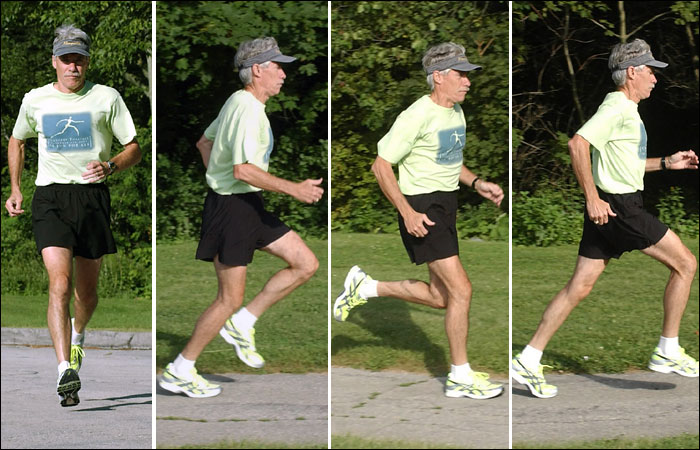 Dr. Robert Fitts demonstrating his running technique. From left, his
feet go one in front of the other while running in a straight line; his
knee is raised with no shuffling; he maintains an efficient stride with
no bouncing; and his arms are kept close to his sides, not pointing
outward.
Correction: Aug. 19, 2004, Thursday
An article in Science Times on Aug. 10 about running techniques
misstated the achievements of one runner, Brook Thomas. Mr. Thomas was
an all-American while running for Stanford University in cross country,
and competed in the Olympic marathon trial in 1972, but dropped out
before the finish. He did not come in fourth.
http://www.primepuzzle.com/runlog/runn.html
Dr. Robert Fitts demonstrating his running technique. From left, his
feet go one in front of the other while running in a straight line; his
knee is raised with no shuffling; he maintains an efficient stride with
no bouncing; and his arms are kept close to his sides, not pointing
outward.
Correction: Aug. 19, 2004, Thursday
An article in Science Times on Aug. 10 about running techniques
misstated the achievements of one runner, Brook Thomas. Mr. Thomas was
an all-American while running for Stanford University in cross country,
and competed in the Olympic marathon trial in 1972, but dropped out
before the finish. He did not come in fourth.
http://www.primepuzzle.com/runlog/runn.html
Tuesday, August 31, 2004 - 7:21:25 AM